Although best known for car racing and Hoosier basketball, Indiana established the first successful commercial wine industry in America.

Toast with wine glasses over Indianapolis.
History of Wine in Indiana
At the turn of the 19th century, Swiss immigrant John James Defour settled on the north side of the Ohio River and planted vines in hopes of producing wine equal in quality to what he left behind in Switzerland. His effort was successful, and he invited his family to join him in his new home to help develop the vineyards. Together, they established a settlement that became the town of Vevey, named after a Swiss Village, and they produced the first wines in America.
By the mid-1800’s, Indiana vineyards along the Ohio River valley were part of the largest wine-producing region in America, known as the Rhineland of America. These wines were easily carried down the river to the eastern seaboard markets, where they became known and appreciated for their high quality and even gained notoriety among wine enthusiasts, including President Thomas Jefferson.
Pre-statehood and well into the late 1800s, the Indiana wine industry thrived and, at its height, ranked 10th in U.S. wine production. But all this changed with the passage of the 18th Amendment in 1919, known as Prohibition, which prohibited the production and sale of alcohol. Indiana vineyards and towns disappeared with the decline of the wine industry and, as in much of the U.S., did not return until deep into the 20th century.
Prohibition ended in 1931, but another law prevented the rebirth of the Indiana wine industry. In 1935, the Liquor Control Act was passed, preventing the direct sale of wine to consumers at wineries, so there was little incentive to establish a vineyard as a business. But in the late 50’s and into the early 70’s, a couple of enterprising individuals began rebuilding the state’s wine industry. In 1958, Dr. Donald MacDaniel planted French Hybrid grapes in Connersville and later established Treaty Line Winery. Bill Oliver followed in 1966, planting 10 acres of vines in Bloomington, thereby establishing the Oliver Winery. Together with Bill Easley of Easley Winery (established 1971), these men helped pass legislation that lifted restrictions on consumer sales at wineries. By 1973, all three had opened their doors to the public, and more wineries soon followed.
In 1989, the Indiana Wine Grape Council was established by the state legislature. Funded with an excise tax on every gallon of wine sold, the council helps to support, grow, and promote the Indiana wine Industry. In 1991, the council collaborated with Purdue University Department of Food Science and Horticulture to create the Purdue Wine Grape Team. The Grape Team’s mission is to serve vintners and growers by providing expertise on viticulture (grape growing), enology (wine making), and marketing. The team established the Vintage Indiana Wine Fest, an annual June wine festival featuring wine tasting, education, food, and music. Unfortunately, the festival was discontinued after the 2020 pandemic.
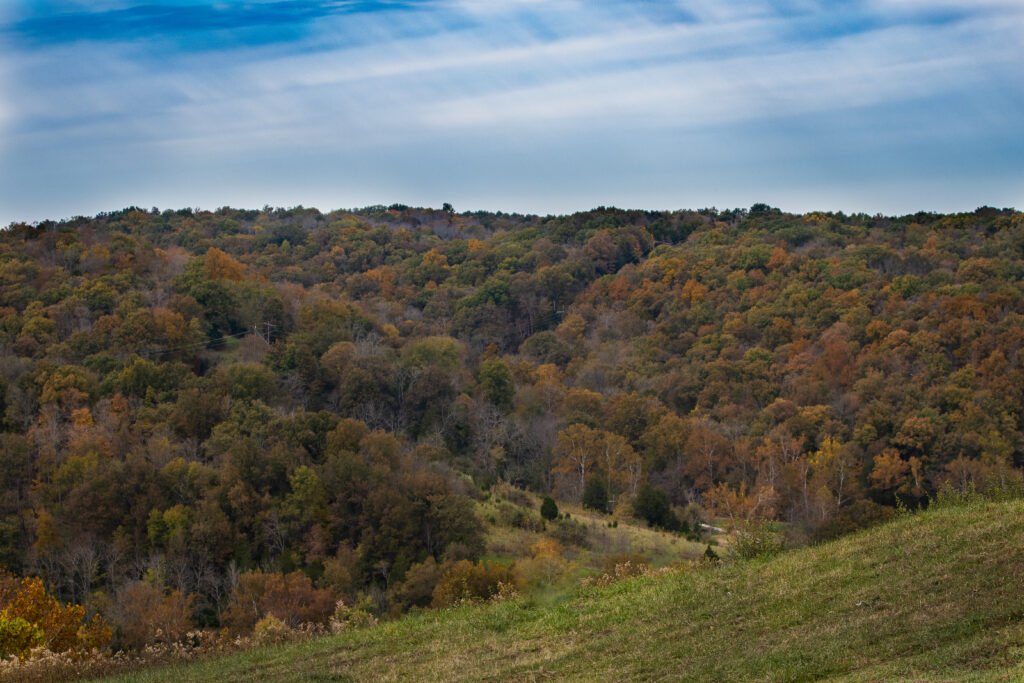
Indiana country side.
Indiana Wine Grapes
According to the Indiana Wine Grape Council website, there are eighteen grape varieties grown in the state, and most are native American or French Hybrid. The signature and official state grape of Indiana is Traminette, a native American grape released by Cornell University in 1996 and grown successfully throughout the state because of its cold hardiness. Traminette has an aromatic bouquet of lilac, vanilla, and rose petals and is made into dry, semi-dry, and sparkling wine styles.
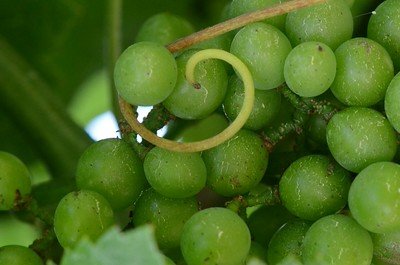
Traminette grapes. Photo by slgkgc via Flickr.
The most popular planted red varietal is Chambourcin, a French hybrid grape that produces wine similar to Cabernet Sauvignon with raspberry, blackberry, and earthy flavors. It can be made in rose, dry, and sweet styles.
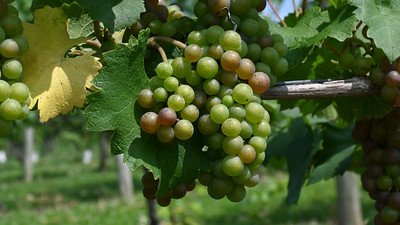
Chambourcin grapes on the vine. Photo by slgkgc via Flickr.
The success of the modern Indiana wine industry has led to the establishment of two American Viticultural Areas (AVA), the Ohio River Valley AVA in 1983, which also contains portions of Kentucky and Ohio, and the Indiana Uplands AVA in 2013, which is wholly located in south-central Indiana and includes the oldest and most productive winery in Indiana, the Oliver Winery.
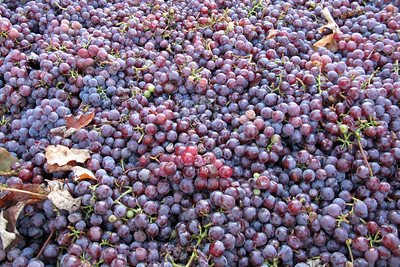
Catawba grapes in south-central Indiana to be turned into wine at Oliver Winery. Photo by Indiana Public Radio via Flickr.
Vineyards in Indiana
Today, there are approximately 115 vineyards and wineries across the state, and over 700 acres are planted with vines. Although most wineries use native American grapes that thrive in Midwest climates, many are also experimenting with international grapes such as Sauvignon Blanc, Merlot, Malbec, and Pinot Noir. To produce these wines, wineries purchase grapes or juice from vineyards in California and other states where these grapes are grown. Many of the wineries offer restaurants and lodging in addition to tasting rooms. To learn more about Indiana wine and wine trails, visit IndianaWines.org, IndianaWineries.com, or pick up a copy of Indiana Wineries: The Ultimate Guide to Wine in Indiana by Todd and Becky Outcalt.
A version of this article was originally written for Recette Magazine, and was published online on June 11, 2021. See the original article here: https://blog.suvie.com/a-beginners-guide-to-indiana-wine. See all of the Fifty States of Wine articles here: https://alwayssharingwine.com/category/asw-blog/fifty-states-of-wine. See all of Susan’s previously published articles here: https://alwayssharingwine.com/tag/previously-published.